

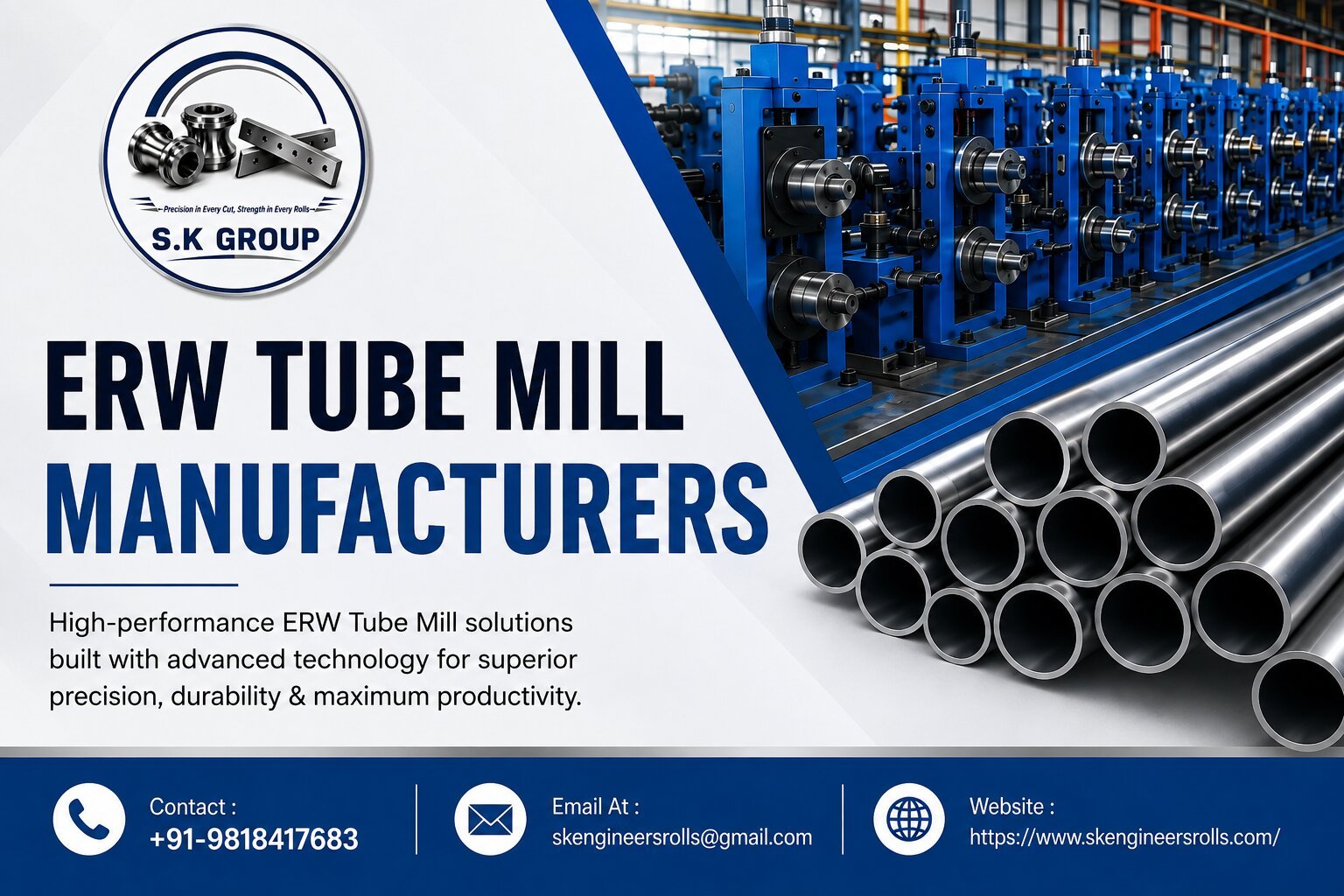
For manufacturers of high-quality welded pipes, the right tube mill is crucial as it affects overall production capacity, the number of workers needed, operating expenses, and consistency in finished product. Leading ERW tube mill manufacturers now provide both semi-automated and completely automated solutions for tube production so that they can purchase the equipment necessary to fit their production goals rather than settling for whatever is available.
What Are ERW Tube Mills
The Electric Resistance Welded (ERW) Tube Mill takes a flat steel strip and runs it through a series of rollers that reshape it into any size or type of hollow tube, round or square. Electrical resistance welds the two edges of steel together. Then it is sized, straightened, and cut to the correct length. Tubings can be made from ERW tube mills for many purposes – construction, water line construction, boilers, water heaters, heat exchangers, and other applications. Today’s tube mills use precision cutting tools and custom-designed sizing setups to produce exactly what is required.
Based on automation level, these are the popular choices of tube mills nowadays:
Semi Automatic: These combine machine-driven production with operator adjustments that control processes. For example, roll settings, monitoring, process corrections, and changeovers require manual intervention.
Fully Automatic: These are set up for continuous production and have very little, if any, operator intervention. The automated controls regulate the forming, cutting, sizing, etc., of the ERW tubes, giving you the same quality ERW tubes over long periods of time.
Key Differences Between Both Operational Modes
Production Rate
Tube mills with semi-automatic operation are best suited for moderate production runs and applications requiring flexibility. Tube mills with full automation are built to run at higher speeds and provide a continuous output, making them ideal for producing high volumes.
Labour Requirements
Semi-automatic tube mills require qualified operators to monitor the entire production process. With the automated control systems of a fully automated tube mill, a small number of people can operate the machinery, as little as one or two people may be required for daily operations, while still being able to produce the same amount of product as semi-automatic tube mills.
Capital Investment
Typically, semi-automatic tube mills will require less capital investment at the start-up than fully automated tube mills. Fully automated tube mills will require more money at start-up; however, they will potentially save businesses money on a long-term basis through productivity improvements, reduced downtime, and a higher degree of consistency in product.
When To Choose Which One
As you consult with the ERW tube mill manufacturers, follow this tip for clarity of choice:
- Choose a semi-automatic tube mill when production speed is moderate, multiple tube sizes are made in small batches, and flexibility is more important than high production.
- Choose an automatic tube mill when you need high production speed, product specifications are consistent, and the business needs to expand its capacity.
Conclusion
When any equipment or machinery is chosen based on production goals, workforce availability, and budget, the right choice is made. Following this approach will help in establishing the tube mill set-up. The best ERW tube mill manufacturers like S.K. Engineers, provide well-crafted machines along with rolls as a comprehensive solution in a single destination.